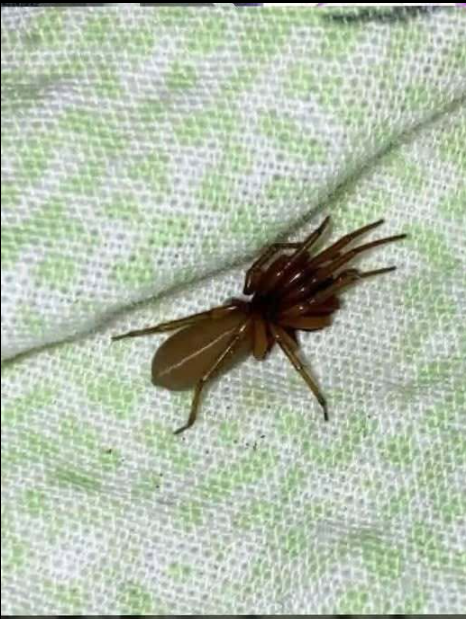
When most people think about spiders, they imagine delicate webs stretched between branches or tucked into corners, waiting patiently for an unsuspecting insect to become trapped. For many spider species, that strategy works perfectly. Yet nature is filled with exceptions, and one particularly remarkable hunter has abandoned the web-building lifestyle almost entirely. Known as the red-fanged wandering spider, this fascinating predator relies not on sticky silk traps, but on speed, stealth, sharp instincts, and highly specialized senses. With its vivid reddish fangs, agile movements, and relentless hunting style, it has earned a reputation as one of the most impressive nocturnal predators in the arachnid world.
Unlike traditional web-building spiders that spend much of their lives waiting for prey to come to them, the red-fanged wandering spider takes a far more active approach. As daylight fades and darkness spreads across the landscape, it emerges from its hiding places beneath rocks, fallen logs, bark, and layers of leaf litter. The night is when this hunter truly comes alive. Rather than remaining in one location, it begins roaming through its environment in search of insects, small arthropods, and other potential prey.
Its success depends largely on its extraordinary sensory abilities. Tiny hairs covering its legs are capable of detecting the faintest vibrations in the environment. A slight movement in the grass, the subtle footsteps of an insect, or the smallest disturbance in the ground can alert the spider to the presence of prey. These highly sensitive structures function almost like an advanced detection system, allowing the spider to gather information about its surroundings without relying solely on vision.
Once it identifies a target, the spider becomes a model of patience and precision. It moves quietly, often approaching with incredible caution. Every step is calculated. Every movement is deliberate. Then, when the perfect moment arrives, it launches an incredibly rapid attack. The speed of the strike leaves prey with little chance to react, turning what seemed like a calm nighttime scene into a sudden display of predatory efficiency.
One of the spider’s most distinctive features is its striking red-colored fangs. These vivid mouthparts are not merely decorative. They serve an essential role in the spider’s hunting strategy. Equipped with venom, the fangs deliver a powerful bite that quickly immobilizes prey. Once injected, the venom begins working almost immediately, preventing escape and allowing the spider to feed safely. This combination of speed, accuracy, and venom makes the red-fanged wandering spider a highly effective hunter capable of capturing prey that many other spiders might struggle to catch.
Despite its intimidating appearance and formidable hunting abilities, this species generally poses very little threat to humans. Like many spiders, it prefers avoiding confrontation whenever possible. Encounters with people are relatively uncommon, and the spider typically chooses retreat over aggression. While its appearance may seem alarming to those unfamiliar with it, the red-fanged wandering spider is far more interested in hunting insects than interacting with humans.